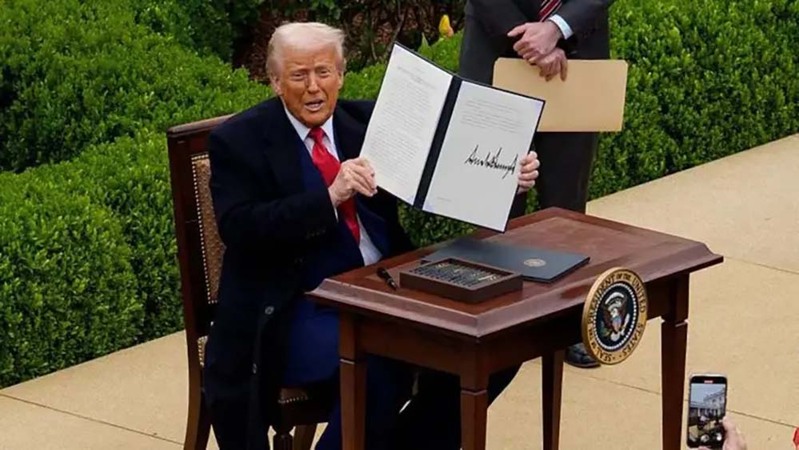

U.S. President Donald Trump has imposed new tariffs on 92 countries, including India, which will come into effect from August 7, 2025. Under this policy, India will face a 25% tariff, Pakistan 19%, and Canada 35%. Trump had initially announced a global tariff policy on April 2, but it was suspended for 90 days. Later, the deadline was extended until July 31 to allow time for trade negotiations. Although the Trump administration aimed to finalize 90 trade deals within 90 days, agreements have been reached with only 7 countries so far. Goods shipped to the U.S. before October 5, 2025, will follow the previous tax rules.
The new tariffs are expected to impact key Indian export sectors such as steel, aluminum, automobiles, textiles, electronics, and jewelry. Countries like Laos, Myanmar, and Syria face the highest tariffs—40% or more. Additionally, if any goods are routed through another country to avoid taxes, a 40% tariff will be applied.
European Union (EU) goods are not subject to a flat 15% tariff. Instead, if a product currently has a 10% duty, only an additional 5% will be added. Products already taxed at 15% or more will not face any new charges. The UK signed a trade deal with the U.S. on May 8, under which tariffs on British steel, aluminum, and cars were reduced. In return, the UK agreed to lower duties on American products such as olive oil, wine, and sports equipment.
Japan also signed a deal on July 22, under which its goods will now face a 15% tariff instead of 25%. Japan committed to investing $550 billion in the U.S. and opening its market to American cars and rice. On July 27, the U.S. and the EU reached a preliminary trade agreement, where the EU agreed to purchase $750 billion worth of U.S. energy over the next three years and invest $600 billion in American pharmaceutical, automotive, and defense industries. However, 30% of goods are still under negotiation.
South Korea also reached a deal with the U.S., reducing tariffs from 25% to 15%, and committed to purchasing $100 billion in energy and investing $350 billion in the U.S. Trump imposed a 19% tariff on Indonesian goods on July 15, but over 99% of American products will enter Indonesia duty-free. Similarly, the Philippines faces a 19% tariff and Vietnam 20%.
In addition to the tariffs, the U.S. has also threatened sanctions against India for purchasing arms and oil from Russia. Responding to this, India’s Ministry of Commerce and Industry said it will take all necessary steps to safeguard national interests in light of the new tariff regime.